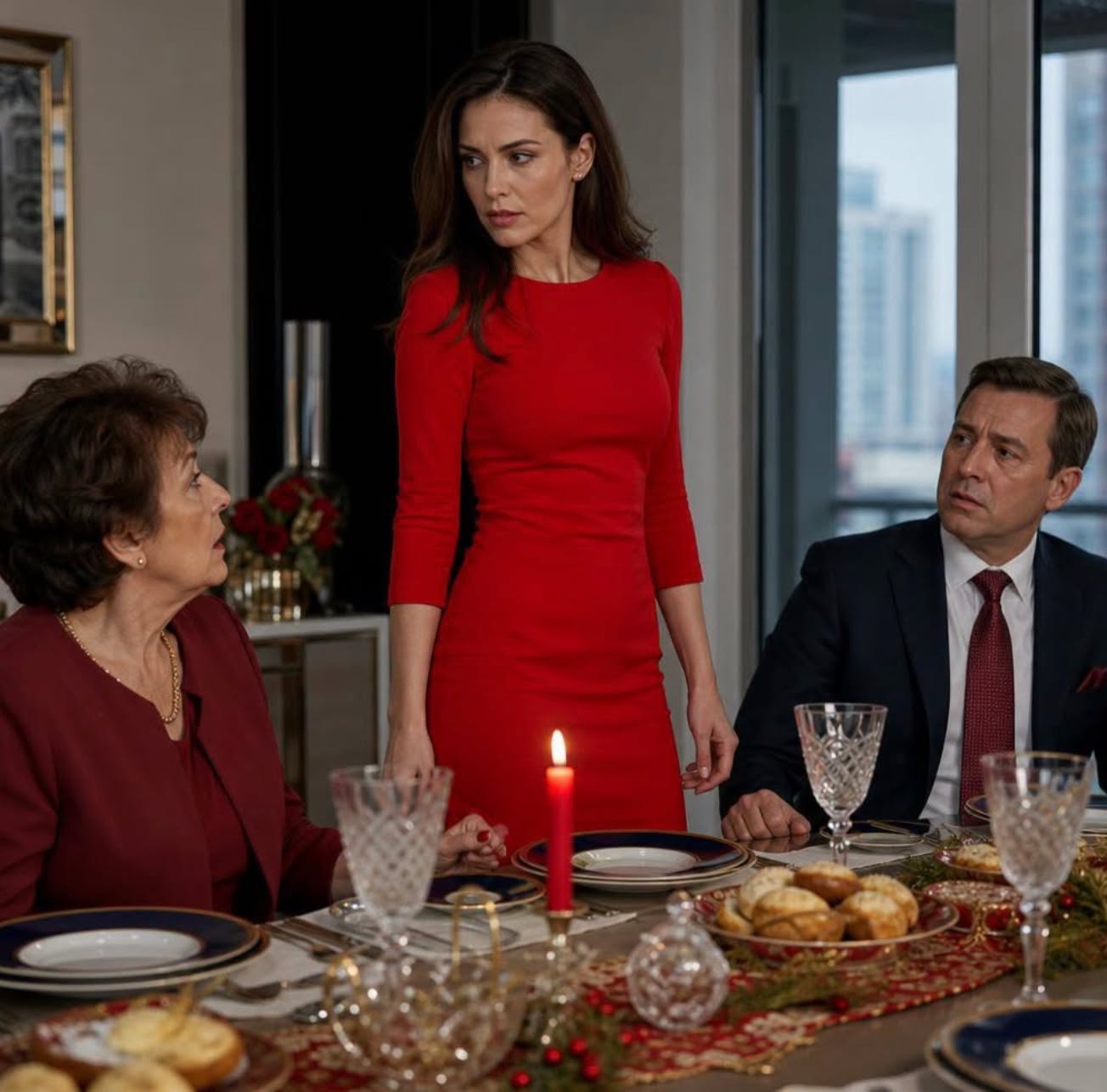
“I’m talking about your saying that Tolya should have married someone else. Someone calmer and simpler.”
The table became completely silent.
Tolya turned toward me.
“Natasha…”
“Please wait,” I said. “I need to say something. Not because I want to ruin the celebration, but because I can’t stay silent anymore.”
Valentina Sergeyevna had already opened her mouth. She had a prepared phrase, I was certain of it. A ready-made explanation.
But I spoke first.
I talked for about ten minutes.
It must have felt long. It was probably uncomfortable for everyone to sit there while a daughter-in-law listed a series of petty grievances at a birthday dinner.
But I spoke calmly.
I didn’t cry.
I didn’t raise my voice.
I simply described the red sock in the washing machine. The salt added to the soup. The oven being turned off that evening, which was why the main course had been delayed.
And then I repeated what I had just overheard.
“I’m not accusing you of doing these things intentionally,” I said at the end, and it was almost true. “Perhaps they were all coincidences. But I want you to know that I hear what you say behind our backs.”
Aunt Galya stared down at her plate.
Yulia looked at my mother-in-law.
Seryozha turned toward the window.
Tolya looked at me.
Then at his mother.
“Mom,” he said.
Just one word.
But there was so much inside it that my throat tightened.
Valentina Sergeyevna said nothing.
For the first time in eight months, she was genuinely silent—without a prepared explanation, without the warm smile, without the usual, “Natalya, dear, what are you talking about?”
She sat upright with her hands folded on the table, staring somewhere beyond all of us.
Then she said, “I’ll go check the meat.”
She stood up and walked into the kitchen.
Aunt Galya was the first to break the silence. She started talking about something trivial. The others joined in, and the conversation slowly resumed—strained at first, then increasingly natural.
Seryozha told a joke.
Yulia laughed.
The party had not died.
It had simply paused.
Under the table, Tolya found my hand and squeezed it.
He said nothing.
Twenty minutes later, Valentina Sergeyevna brought out the pork roll.
The meat had finished cooking. It was golden, fragrant, and covered with a crisp crust.
She placed the platter on the table and said evenly, “Natalya made the main course. She worked very hard on it.”
Nothing more.
No explanations.
No apology—not yet.
But there was no smile and no false warmth, either.
Only a fact, spoken aloud in front of everyone.
I put a slice of pork on my plate and tasted it.
It was good.
I had cooked it well.
That night, after the guests had left, Tolya and I lay awake in the darkness for a long time.
I knew he wasn’t sleeping. I could hear it in his breathing.
“Why didn’t you tell me?” he finally asked.
“Because I couldn’t prove anything. And because I didn’t want to put you between us.”
“You put me between you tonight.”
“Yes,” I agreed. “But there was no other way anymore.”
He was silent for a moment.
Then he said, “I’ll talk to her.”
“I know.”
“Natasha… I’m sorry I didn’t notice.”
I reached for his hand in the darkness.
“You weren’t supposed to notice. She made sure it was invisible. That was the whole point.”
Valentina Sergeyevna and I didn’t speak for three days.
We lived in the same apartment, greeted each other, and passed the salt across the dinner table.
Tolya spoke to her.
I don’t know exactly what he said. He never told me, and I never asked.
That conversation belonged to the two of them, not to me.
On the fourth day, she entered the kitchen while I was making coffee.
She stopped in the doorway.
“Natalya.”
I turned around.
Valentina Sergeyevna stood straight, as always, and looked directly into my eyes, also as always.
But there was something different about her face.
Something I didn’t understand at first.
Then I realized what it was.
She looked tired.
Simply tired—without the mask of warm hospitality and without a prepared speech.
“I’m not going to claim I didn’t do anything,” she said slowly. “And I’m not going to ask you to forget it. I only want to say that… I needed time to adjust.”
“I understand,” I said.
“No, you don’t.”
She shook her head.
“You can’t understand. Tolya is my only child. I raised him. And when he brought you here…”
She stopped speaking and looked toward the window.
“It was fear,” she finally said. “A small, ugly fear that he wouldn’t need me anymore. And I handled it… badly.”
I said nothing.
The coffee was beginning to boil.
“I’m not asking you for anything,” Valentina Sergeyevna added. “I just want you to know.”
She turned and left the kitchen.
I remained by the stove, thinking that revenge, once achieved, was nothing like the sweet triumph people imagined.
It was bitter and complicated—like the coffee I had forgotten to remove from the heat.
Six months later, we finally saved enough for the down payment.
Our apartment smelled of fresh plaster and new wallpaper. I stood in the middle of the empty rooms and couldn’t stop smiling.
Valentina Sergeyevna came to the housewarming with a cake.
We drank tea while sitting on unopened moving boxes because the furniture had not arrived yet. She told us how she had once received her first apartment.
I listened and thought that she could be a genuinely interesting person when she wasn’t afraid.
Nigdy nie zostaliśmy bliskimi przyjaciółmi.
Prawdopodobnie nigdy nie będziemy.
Ale nauczyliśmy się siedzieć przy tym samym stole, nie licząc żalu, a druga ukrywała swoje obawy za ciepłym uśmiechem.
Pewnego wieczoru, gdy wychodziliśmy, Walentyna Siergiejewna zatrzymała mnie przy drzwiach.
“Natalya,” powiedziała. “Ta rolka wieprzowina wyszła bardzo dobrze.”
Spojrzałem na nią.
W jej oczach nie było drwiny.
Żadnych kłamstw.
Tylko zmęczona, lekko niezręczna próba wyciągnięcia ręki.
“Wiem,” powiedziałem. “Jestem dobrym kucharzem.”
I to była prawda.